“Then God said, ‘Let us make mankind in our image, in our likeness…'” (Genesis 1:26)
Before there were governments, economies, or charitable organizations, there was a profound truth at the heart of creation: every human person was created in the image and likeness of God. Our dignity is not earned by education, wealth, status, or productivity. It is a gift bestowed by our Creator.
Yet Scripture also reminds us that we were not created merely to exist—we were created to participate.
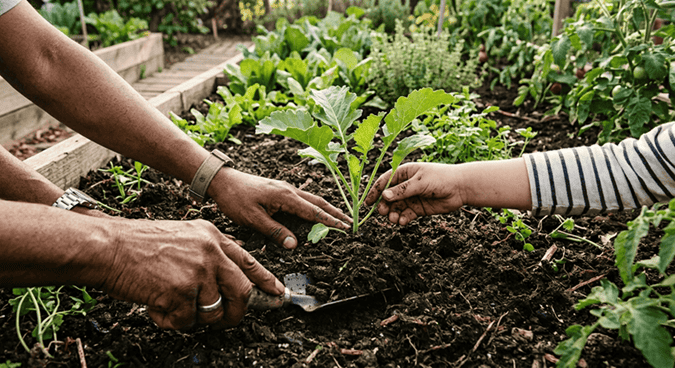
In the Garden of Eden, God entrusted humanity with the care of creation:
The Lord God took the man and put him in the Garden of Eden to till it and keep it.”
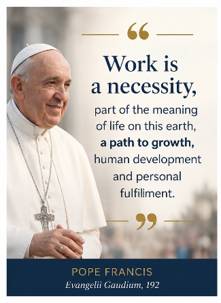
From the very beginning, God’s plan was that each person would use the gifts He had given them to cultivate, create, serve, and build up the world around them. Work, stewardship, and community are not simply economic activities; they are part of our vocation as children of God.
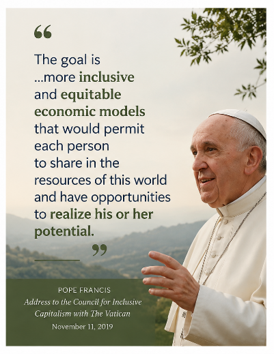
One of its central principles is Participation—the belief that every person has both the right and the responsibility to contribute to the economic, social, cultural, and spiritual life of their community. Participation is possible because every person possesses an inherent dignity that deserves to be recognized, respected, and nurtured.
Over the past several months, we have introduced you to remarkable individuals and communities across Africa. At first glance, their stories may appear very different. One month we reflected on survivors of human trafficking. Another month we celebrated young people embracing digital evangelization. We shared the courage of communities responding to the Ebola crisis and the hope found in forming young leaders for tomorrow.
These were not separate stories.
They were different expressions of the same Christian vision.
When we accompanied survivors of human trafficking, our goal was never simply to rescue someone from exploitation. Rescue is only the beginning. True restoration means helping each person reclaim the freedom to make choices, rebuild relationships, discover their God-given gifts, and once again participate fully in the life of their family, Church, and community.
When we highlighted young people using digital platforms to share their faith, we were not simply embracing new technology. We were witnessing a new generation accepting responsibility for evangelization and using their gifts to proclaim Christ in places where others may never reach.
When we reflected on communities responding to the Ebola outbreak, our focus was not only on medical care. We saw local leaders, volunteers, and parishes strengthening their capacity to protect one another, care for the vulnerable, and become instruments of healing within their own communities. Alongside this was the profound realization that even in the midst of disaster, life must continue. Children still need to learn, families must still provide for one another, communities must still worship, and hope must still be nurtured.
Likewise, when we shared stories of youth formation and leadership development, our hope extended beyond a successful workshop or training session. We envisioned young women and men discovering their vocation, becoming servant leaders, and helping shape the future of both the Church and society.
Each of these stories points to the same truth.
Authentic development is not simply about providing services. It is about restoring people to the vocation God intended for them from the very beginning.
This understanding challenges us to think differently about impact.
Too often, success is measured only by the number of meals served, scholarships awarded, workshops delivered, or families assisted. These are important expressions of Christian charity, but they do not tell the whole story.
The deeper question is this:
Has this investment enabled someone to participate more fully in the life God created them to live?
When a survivor becomes an advocate…
When a young entrepreneur creates opportunities for others…
When a parish develops local leaders…
When a young Catholic confidently shares the Gospel through digital media…
When a community gains the knowledge and confidence to respond to a public health crisis…
Participation has been restored.
Saint Paul reminds us that “there are varieties of gifts, but the same Spirit” (1 Corinthians 12:4). God has entrusted every person with unique gifts intended not only for personal fulfillment but for the building up of the Body of Christ. Authentic development creates the conditions in which those gifts can flourish.
This is why PACTPAN measures impact differently.
Our goal is not simply to deliver programs. It is to accompany communities as they develop the capacity to lead, innovate, and transform their own futures. Whether combating human trafficking, strengthening healthcare, forming young leaders, or expanding opportunities for evangelization, we seek to restore people’s ability to participate fully in the life of their families, their communities, and the Church.
For our donors, this offers a richer way of understanding generosity.
Rather than asking, “What did my donation purchase?”, we invite you to ask:
- Whose dignity was strengthened?
- Who now has the opportunity to contribute to their community?
- What seeds of hope have been planted that will continue bearing fruit long after today’s project is complete?
These are the questions that reflect the heart of Catholic Social Teaching.
Your generosity is far more than financial support. It is an investment in human dignity. It helps restore participation, strengthen communities, and create opportunities for people to become active partners in God’s ongoing work of renewal.
Together, we are doing more than meeting today’s needs.
We are helping build a future where every person has the opportunity to flourish, to share the gifts God has entrusted to them, and to participate fully in creating a more just, compassionate, and hope-filled world. In doing so, we become partners in God’s work of restoring His creation—one person, one community, and one life at a time.