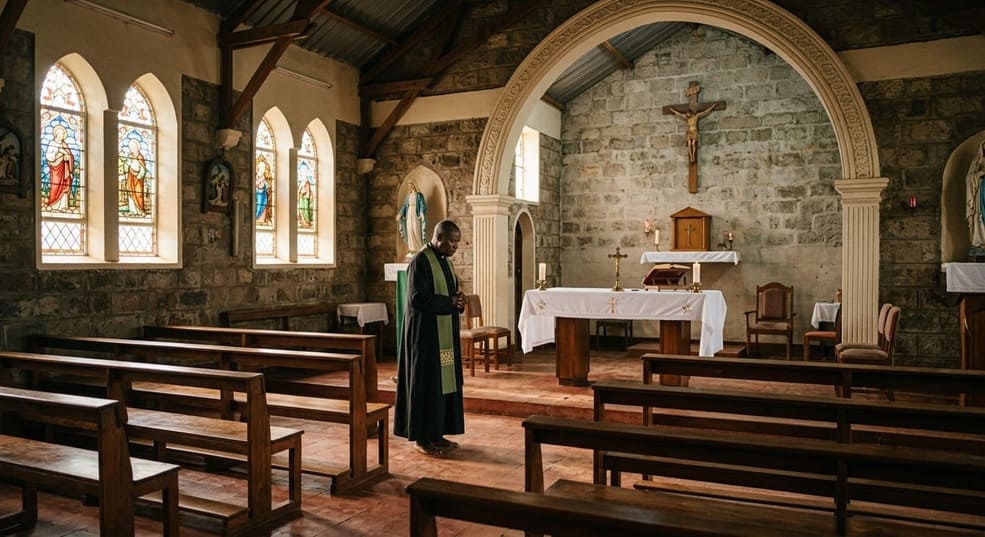
We often see the shepherd standing beside his flock.
We see him celebrating Mass, visiting the sick, listening to a family in crisis, burying the dead, counseling those who seek his guidance and sharing in the joys and sorrows of the community he serves.
What we do not always stop to consider is what he may be carrying while he stands there.
A priest may spend his morning celebrating Mass, his afternoon visiting the sick and his evening listening to a family in crisis. The following morning, he rises and begins again.
This is the ordinary rhythm of a vocation centered on service. But what happens when the ordinary responsibilities of ministry meet extraordinary circumstances? What sustains the shepherd who must continue tending the flock while walking through the same storm?
When Life Does Not Stop for Crisis
A few months ago, we reflected on the reality that life does not stop because disaster arrives. An epidemic may dominate the world’s attention, but the ordinary needs of families do not disappear. During an Ebola outbreak, children still need care. People still become sick from other illnesses. Families still need food. People still die and families still grieve. Life continues underneath the emergency.
So does ministry.
The priest does not stand outside the circumstances affecting his community. He lives within them. When disease comes, he too lives with its uncertainty. When economic hardship affects a community, the needs arriving at the parish door often increase. When families experience displacement or insecurity, the priest accompanies people whose lives have been disrupted.
When violence enters a community, he may mourn the same losses and confront the same uncertainty as the people he serves. And yet the sacramental and pastoral life of the community continues. There are still people who need the Eucharist. There are still children to baptize. There are still couples preparing for marriage. There are still people who need reconciliation, families who need counsel, sick people who need visiting and loved ones who need to be buried.
Crisis does not suspend the call to shepherd.
When Standing Beside the Flock Carries Risk
In parts of Nigeria, the weight of that pastoral presence has for many years taken on another dimension.
In March 2025, Vatican News reported figures compiled by the Fides news agency showing that 145 Catholic priests had been kidnapped in Nigeria between 2015 and 2025. Eleven had been killed. The experience is not uniform across the country; some ecclesiastical provinces are affected much more severely than others. Vatican News
The danger continues. In February 2026, armed attackers entered the residence of Fr. Nathaniel Asuwaye, parish priest of Holy Trinity Church in Karku, Kaduna State. Ten parishioners were also abducted and at least three people were killed. Fr. Nathaniel spent three months in captivity before being released in May. Vatican News
These stories are not offered to define priesthood in Nigeria by violence, nor should the experience of one country or region be used to describe priestly ministry across a continent as diverse as Africa. Instead we bring them in as an invitation for us to instead collectively notice something easily overlooked.
The shepherd may be walking through the same storm as the flock.
He may know fear and uncertainty while being called to reassure others.
He may grieve while accompanying those who grieve.
He may be confronted by needs far greater than the resources immediately available to him.
He may carry responsibility for a community while also carrying the ordinary human concerns of his own life.
The depth of that challenge does not speak to weakness in the priest.
It speaks to the weight of what he is being asked to carry.
“Feed My Sheep”
After the Resurrection, Jesus asks Peter three times, “Do you love me?” Peter’s profession of love is followed by a commission: “Feed my sheep.” Those words have echoed through generations of priestly ministry. But tending the flock has never meant standing apart from it.
The priest lives among the people he serves. He comes to know their families, their hopes and their struggles. He celebrates their milestones and enters their homes in moments of sorrow. In many communities, he may also become someone people approach when problems extend far beyond what we would traditionally think of as sacramental ministry.
That closeness is part of the beauty of pastoral ministry. It can also carry considerable weight. And the challenges confronting communities do not remain static. The realities a priest encounters today may be very different from those he anticipated when he first entered formation.
This raises an important question for the Church:
If the realities surrounding ministry continue to change, how can formation continue alongside them?
Formation Does Not End at Ordination
Ordination marks the beginning of priestly ministry, not the end of formation. The priest who has committed his life to serving God’s people continues to encounter new circumstances, new responsibilities and new pastoral questions. Continuing formation is therefore not an indication that his original preparation was somehow inadequate.
It recognizes something much more fundamental:
Ministry continues to ask new things of him.
Leadership develops with experience. Communities change. New social challenges emerge. Healthcare needs change with age. Administrative and financial responsibilities require knowledge. The realities confronting the people he serves may demand pastoral responses that could not have been fully anticipated years earlier.
And there are questions about the priest’s own journey through ministry: fraternity, health, responsible stewardship and eventually preparation for retirement. These are not separate from vocation.
They are part of sustaining a vocation across a lifetime.
Creating Space for Conversation
This understanding sits at the heart of PACTPAN’s Training on the Renewal of Priestly Ministry Program.
Through its six-session Palaver Series in Nigeria, PACTPAN has created space for priests to engage issues including self-care, the demands of ministry, fraternity, pastoral leadership, healthcare, financial accountability and retirement. In sharing the work of the program with me, Dr. Florence Onubogu, Executive Director of Friends of the Pan-African Catholic Network, offered an important perspective: “This is not about simply asking priests to endure more; it is about enabling them to serve sustainably, lead responsibly and prepare for the future.”
There is something particularly fitting about the idea of palaver.
It creates room for conversation.
For listening.
For sharing experience.
For asking questions that may not always have an obvious place within the everyday demands of ministry.
And perhaps, most importantly, for priests to learn from one another.
A priest brings years of lived pastoral experience into that conversation. Another brings experience from a different community. Formation can bring additional knowledge and tools. Fraternity creates the opportunity to recognize that difficult questions do not always have to be carried alone.
This is not about taking responsibility for the priest’s vocation.
It is about ensuring that opportunities for growth continue alongside the vocation.
Those Who Accompany Also Walk the Road
In our previous reflection, we considered Ubuntu, solidarity and accompaniment—and the idea that genuine accompaniment does not mean taking over another person’s journey.
It means walking beside them.
Priests understand this perhaps better than most us who sit in the church pews.
Much of pastoral ministry is accompaniment.
The priest cannot remove another person’s grief, but he can stand beside the family that grieves.
He cannot make every difficult decision for those who seek his counsel, but he can help them discern.
He cannot eliminate every hardship affecting his community, but he can remain present within it.
And perhaps that same understanding helps us appreciate what continuing formation offers.
We are not being asked to carry the shepherd’s vocation for him.
We are recognizing that those who spend their lives accompanying others are themselves still walking a road.
And that road changes—sometimes rocky, sometimes smooth, carrying us through the sorrows and storms of life, as well as the joys that sustain us along the way.
Strengthening the Shepherd Strengthens More Than One Person
This is where PACTPAN’s work speaks directly to its broader mission of building capacity.
Capacity building is not simply about addressing a deficiency.
It is about recognizing what already exists and strengthening the knowledge, skills, relationships and resources that allow it to flourish.
The priest already brings vocation.
He brings formation.
He brings experience.
He brings knowledge of his community.
He brings relationships built through years of presence.
Continuing formation builds upon that foundation.
And its impact does not necessarily stop with the individual priest.
Knowledge gained in pastoral leadership returns to the parish.
Better stewardship can strengthen the administration of community resources.
Fraternity can strengthen ministry.
Greater understanding of healthcare and preparation for later life can help a priest make responsible decisions about his future.
The investment travels with him into the places where he serves.
PACTPAN sees an opportunity for accessible formation to reach more priests, sisters and religious leaders across Africa, providing practical knowledge around leadership, pastoral care, stewardship, wellbeing and preparation for the future.
What Does the Shepherd Carry?
Perhaps when we look at a priest standing at the altar, visiting a family or walking through his community, we see the ministry before we see the person carrying it. We see the shepherd. We see the flock.
But we may not see the weight. Some of that weight is inherent in a life freely given to service. Some comes from the trust people place in their priest. Some comes from leadership. And sometimes it comes from circumstances neither priest nor community could ever have chosen: disease, poverty, insecurity, violence or loss.
Yet the shepherd continues to walk beside his flock. The question is not whether someone else should carry his vocation for him. The question is whether the formation and opportunities available to him can continue to grow as the realities of ministry change. For Friends of PACTPAN, perhaps that is where our own role comes into view. Not to direct. Not to presume that we know what a priest or community needs. Not to carry a vocation that belongs to another. But to recognize the value of creating spaces where experience, formation, fraternity and practical knowledge can come together.
Because we often see the shepherd standing beside his flock.
We don’t always stop to consider what he may be carrying while he stands there.
And perhaps understanding that weight helps us understand why strengthening those who shepherd can ultimately strengthen the communities they have committed their lives to serve.
Pam Matambanadzo